
Frank Egler and Rachel Carson
Rachel Carson
“Perhaps the finest nature writer of the Twentieth Century, Rachel Carson (1907-1964) is remembered more today as the woman who challenged the notion that humans could obtain mastery over nature by chemicals, bombs and space travel than for her studies of ocean life.” — Linda Lear

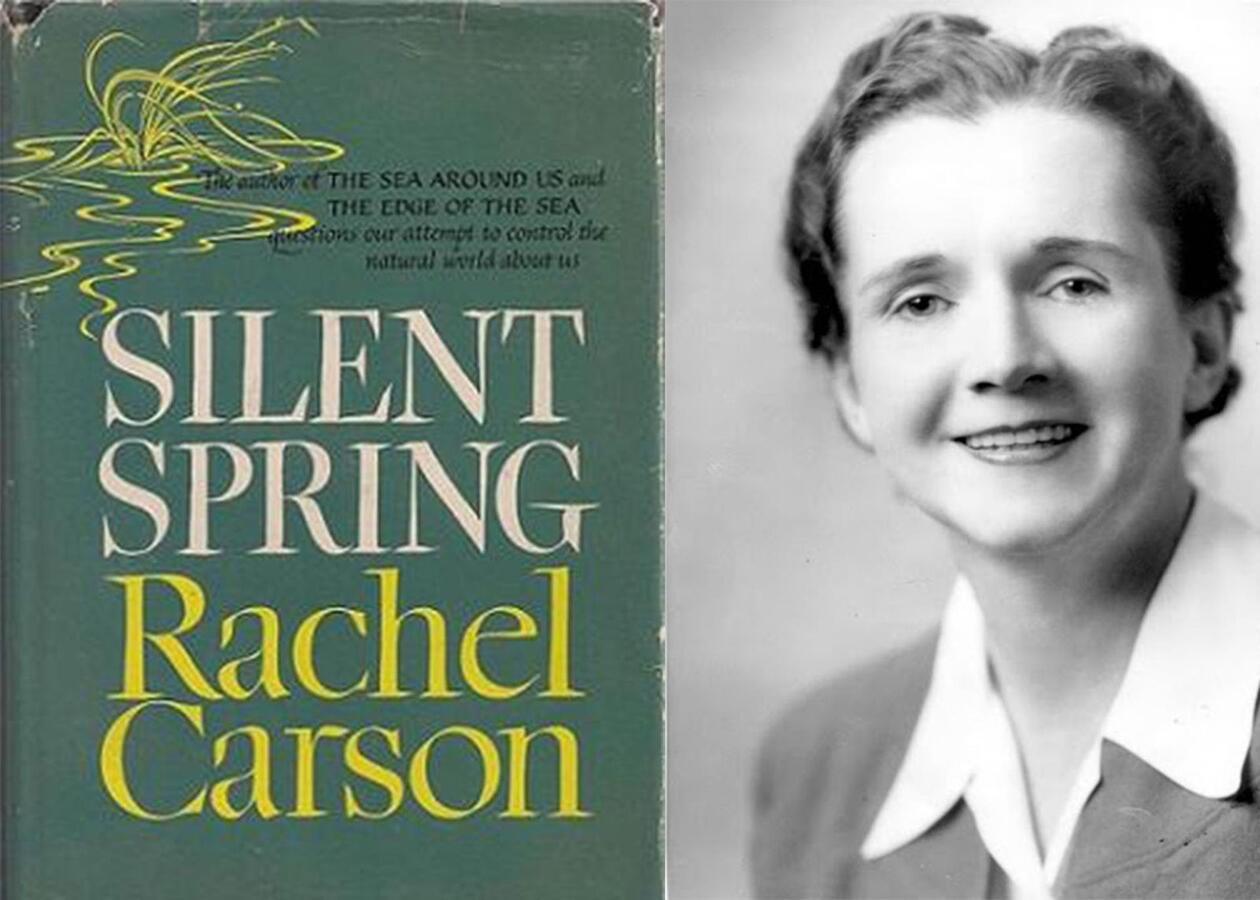
Photo Credit USFWS | Public Domain | Silent Spring Rachel Carson Book Coverf
This AF webpage can not begin to describe the impact of her work. In 2009, Linda Lear wrote the definitive biography of Rachel Carson: Rachel Carson: Witness for Nature. See Rachel Carson website Life and Legacy of Rachel Carson. See the new work of the Carson Springsong Museum in Silver Spring Maryland (expected opening in 2028) under the leadership of Rebecca Henson and others.
THE BEGINNING
Frank Egler and Rachel Carson had a noteworthy professional relationship. Frank Edwin Egler (April 26, 1911 – December 26, 1996), the American plant ecologist and pioneer in the study and groundbreaking research of vegetation science and management, actively influenced Rachel Carson (1907–1964) on chapters of Silent Spring.
In 2016, William Dritschilo wrote an epistolary biography about Dr. Egler, Magnificent Failure: Frank Egler and the Greening of American Ecology, An Epistolary Biography. This book, as well as Linda Lear’s seminal biography of Carson in part capture the relationship between the two ecologists. Additional work is required to more fully document and understand their interaction.
Frank Egler’s ecological circle was a wide one, encompassing scores of noteworthy scientists of his day. Frank’s work initially garnered the attention of Rachel Carson in 1960, when she was directed by Fairfield Osborn to Frank’s comments in the 1959 Conservation Foundation pesticide conference [RC to FE 11.7.60]. While writing Silent Spring, Rachel turned to him for material on the selective use of herbicides as an alternative to the blanket spraying which they both loathed.
SILENT SPRING PERIOD
It was early January, 1962 when Frank sent 12 single-spaced pages of suggestions for “The Earth’s Green Mantle,” Chapter 6 in Silent Spring, Rachel responded, “I am quite overwhelmed at the thought of the hours you must have spent in reading and commenting on my manuscript… I would never have dreamed of asking you for so much time and I am more grateful than I can say for the very substantial help you have given me” [RC to FE 1.17.62]. He sent her references to back up all of her questions, knowing how the industry would tear her apart. Frank told Lear she then phoned him several times for clarifications before sending off the manuscript. It was during this time that the two became trusted correspondents, confidants, even, and he a staunch defender of her book when the chemical lobbies sought to discredit it.
“The Earth’s Green Mantle,” Chapter 6 in Silent Spring, mentions Egler by name, “fully adopting my views,” he later wrote, “citing many of my papers, with many of my papers cited in the references at the end. I could catch other statements in the book that clearly revealed my influence.” The chapter generates outrage over the loss of roadside right of way, citing their beauty and their importance as pollinator habitat. When she describes Frank’s work with selective spraying to create stable shrub habitat that preserves the scenery and the habitat integrity, it could not appear a more perfect solution. Frank called it “the greatest success yet in my life.”
In a 1961 letter to Rachel Carson, Frank stated that he had become “angry and disillusioned” at the beleaguered state of science, which he and Carson often discussed. Frank’s correspondence reveals how his work with right of way vegetation management often put him at odds with industry. One can see the genesis of his cynicism toward the relationship between science and industry and the public good, which led him to be such a valuable resource to Carson. After Silent Spring’s release in September 1962, he wrote her, “I am overwhelmed to the point of silence… What you have done is already changing the roadside picture of America. It is a turning of the tide on a scale I had never dreamed would be possible.”
EGLER DEFENSE
In the months that followed, Frank and Carson invigorated each other. During one memorable speech against the chemical industry’s attacks, Carson was emboldened by Frank’s indictment in the Atlantic Naturalist of scientists on the payroll of industry releasing pro-spraying pesticide reports. According to Lear, Rachel told Frank that “the timing of his review and another paper of his had influenced her thinking and encouraged her ‘to take a few pokes myself at the industry-science relationship.’” He wrote scathing articles defending her against critics, some published, some not. Her fame buoyed his ideas and launched him, according to William Dritschilo, “into a more intensive crusade against pesticide manufacturers and the agricultural establishment.” Editors who wouldn’t touch controversy now published his work; he and others rode “the wave that washed through society because of Silent Spring.”
Frank finally met Carson in Boston in January 1963, at her lecture to the New England Wildflower Preservation Society. He was charmed by her. They talked “quite extensively” about brush control and right of way issues before she gave her talk “in a quiet but firm voice.” As Lear notes, Carson highlighted Frank in this talk, his work with selective spraying as an alternative, and his formation of the service organization RRA, or Rightofway Resources of America. Frank wrote that she called it “the most significant development in recent months in the pesticide problem.”
In Silent Spring, Carson had catalogued the extent of the problem. Frank, through his decades of work in vegetation management at Aton Forest, provided that piece so crucial to any environmental crusader arguing against something: an alternative.
During Carson’s congressional testimony, Frank was one of the people she suggested for an advisory panel on pesticides. She wrote to him wanting to talk about his ideas on disseminating information on pesticides. (She also, though she hid her cancer from many close friends, told him she was ill, but made him promise not to tell.) She plugged him again in a September 1963 Audubon Magazine article, “Rachel Carson Answers her Critics.”
THE END
He wanted to write “A Review of Reviews of Silent Spring,” to “undermine some of the effective industrial critiques,” but her literary agent refused, to his indignation. Nonetheless, he spent three days at her house outside D.C. in Silver Spring, Maryland to see “what she had accumulated in the way of industrial opposition to her book.” He was “most favorably impressed with the lady” and even recorded matter-of-factly that he found her attractive. About her big box of newspaper clippings he wrote, “I was confused, and asked several times: They were all pro-Rachel Carson. There was not one anti-Silent-Spring article! No, she said, there are none! And so I left the Washington area.”
Frank was with his mother and his future wife when a notice came over the television in April 1964 that Rachel Carson had died. “I was unprepared… I broke down completely,” he wrote. His correspondence is peppered with references to her, admiration that perhaps fell just short of jealousy at her not only standing up to industry, but urgently “communicating what was already known” to the public. His letters are replete with gripes over a scientific community that walled itself away from politics, too timid to stir up controversy, and although he had tried, “It took Rachel Carson to inform the public.”
When Linda Lear was writing her definitive biography of Rachel Carson, she interviewed Frank and was given access to Frank’s archives. In recent years, Aton Forest has discovered 20 additional letters from Rachel to Frank, mostly from 1960 to 1963, bringing our total collection to 26 letters from Rachel Carson to Frank, plus many of Frank’s retained carbons of his letters to Rachel, giving us a unique opportunity to have access to both sides of their conversation.
The Linda Lear Archives at Connecticut College, the Beinecke Library at Yale, and Aton Forest have materials related to their relationship. Aton Forest is in the process of reaching out to both institutions, to further enrich our understanding of the important relationship between these two visionary environmental scientists.
Aton Forest is a non-profit land protection organization and ecological field station, created for preservation of Natural Area Preserves (semi-managed and wild lands), operated for ecological and forest succession research in northwest Connecticut and surrounding bioregion.
Learn More
Get an overview of Frank Egler and other ecologists, and their contributions.
Resources
Learn More | Rachel Carson
Rachel Carson: Home
Life and Legacy | Rachel Carson
Rachel Carson: Biography
Publications | Rachel Carson
Rachel Carson: Books
Springsong Museum
Future Museum Site:
10701 Columbia Pike
Silver Spring, Maryland 20901
Silver Spring resident Rebecca Henson founded the museum to be a place of joy and solace that would share Rachel Carson’s love of nature and sense of wonder with our local community and far beyond.
At Springsong Museum, children and adults, locals and tourists alike, will engage with Carson’s ecological philosophy and powerful sense of wonder.